
Home › Insulation › Epoxy Powder Coated Busbar
Epoxy Powder Coated Busbar: Insulation Specs and Design Rules
An epoxy powder coated busbar is a copper bar insulated by spraying charged thermosetting powder onto the preheated part, where it melts and cures into a hard, void-free film. It gives higher dielectric strength per millimeter than dipped PVC and holds tighter dimensions, which suits a part that must fit a machined pocket.
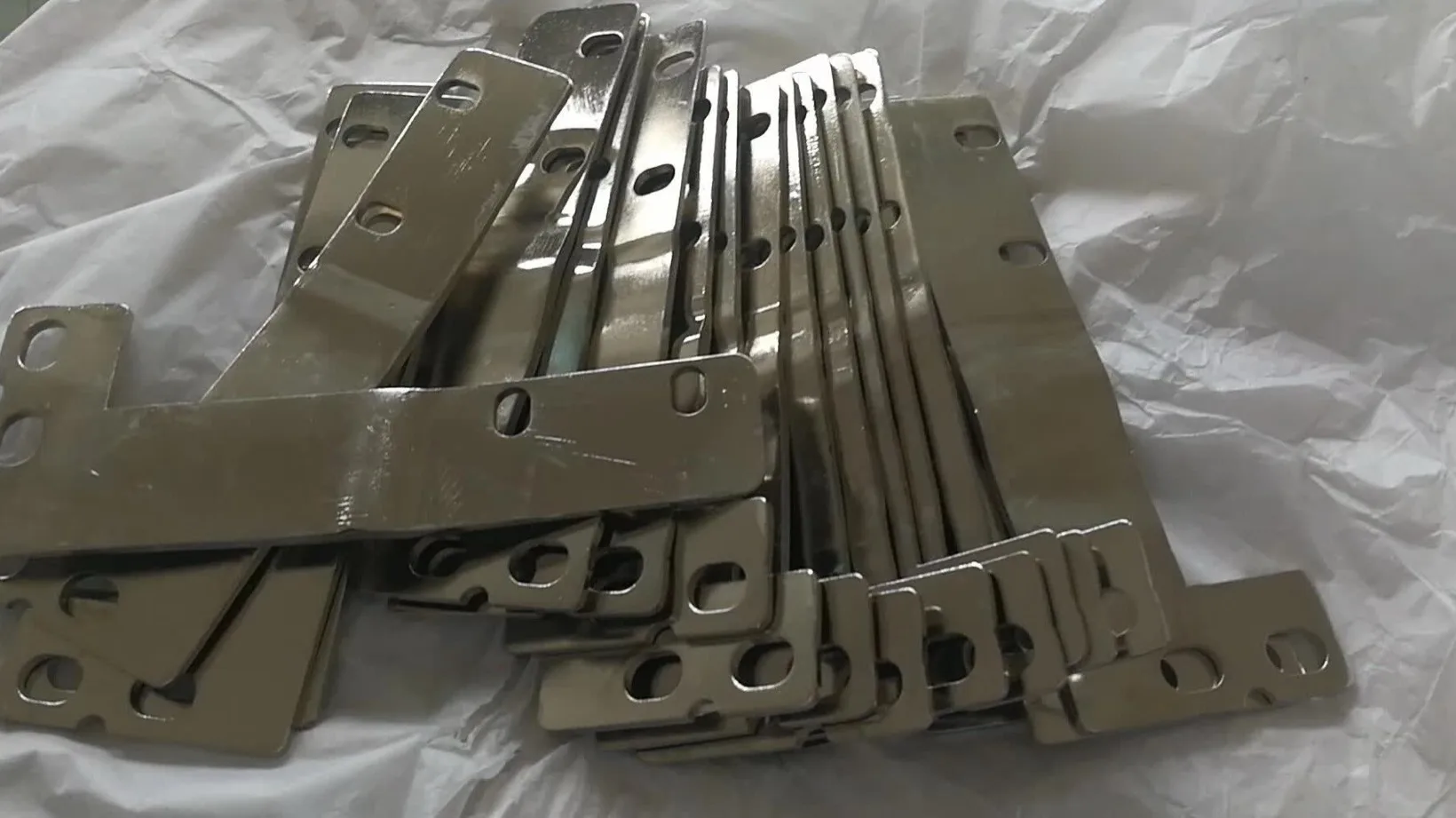
What the coating actually does
Three jobs, in order of importance. It insulates, so that a bar carrying several hundred volts can sit millimeters from a grounded enclosure. It protects the copper from moisture and handling damage. And it holds its shape: because the film is thin and dimensionally stable, a coated bar still drops into the pocket it was designed for.
Thermosetting epoxy cross-links during cure, so unlike a thermoplastic it does not soften and flow when the busbar runs hot. That is what allows a higher continuous temperature rating than dipped PVC, and it is the main reason powder is specified for parts sitting next to power modules.
How the powder is applied
Copper arrives punched, bent and plated. It is cleaned, because powder will not adhere through oil or oxide, and often lightly abraded to give the film something to key into. Contact pads, holes and weld zones are masked. The part is preheated, then powder is sprayed through an electrostatic gun that charges each particle so it wraps around edges rather than only hitting the face pointed at the nozzle. The part goes into an oven, where the powder melts, flows and cross-links. Masking comes off after cure.
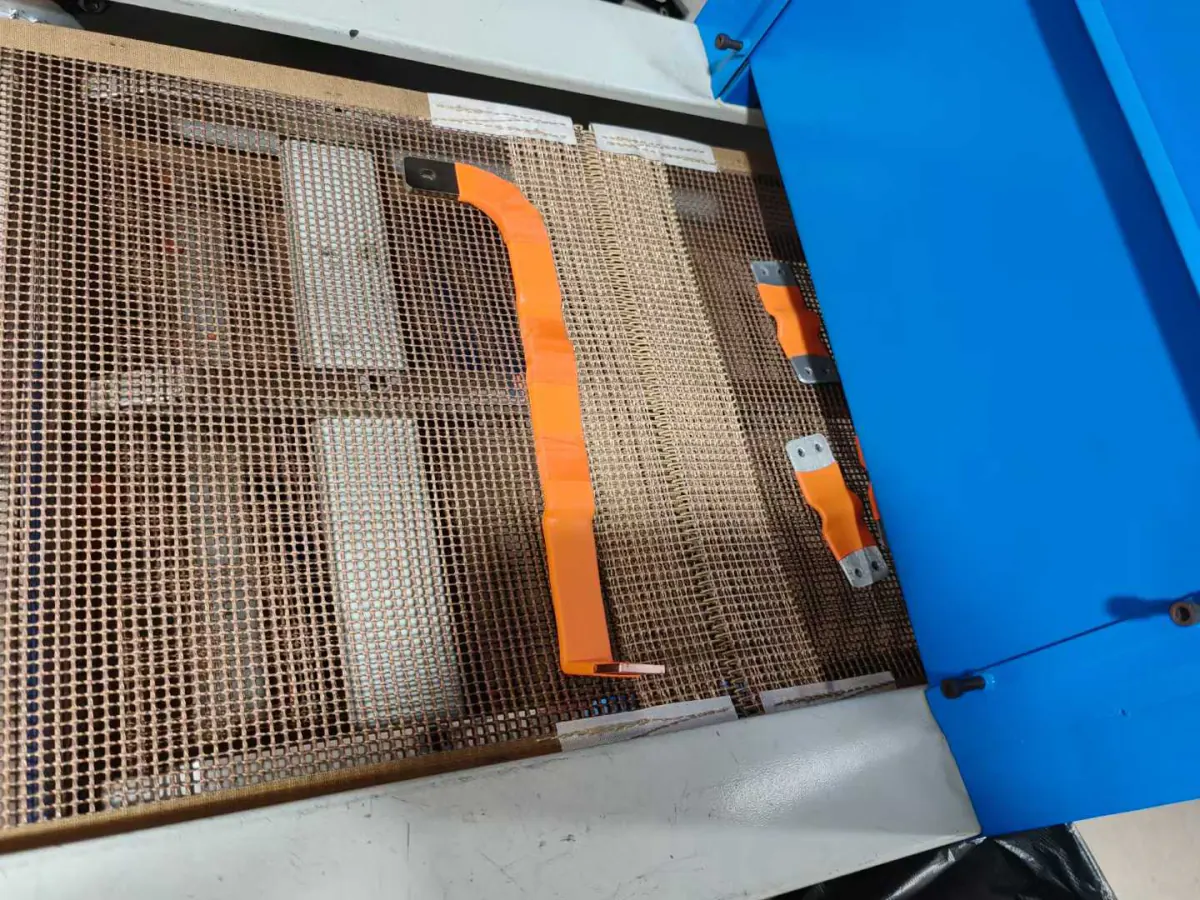
Electrostatic wrap is why powder covers a punched edge better than liquid paint. It is not unlimited, though. Deep recesses and the inside of tight bends see a weaker field and pick up less material, which is where thin spots appear if the geometry has not been reviewed first.
Coating specification
| Property | Typical range | Note |
|---|---|---|
| Coating thickness | 0.3 to 0.6 mm | Built in passes where higher withstand is needed |
| Dielectric strength | 20 to 40 kV/mm | Material property, not a finished-part rating |
| Continuous temperature | Higher than dipped PVC | Depends on the powder grade specified |
| Colors | Red, black, blue, green, yellow | Phase or polarity identification |
| Edge coverage | Good, via electrostatic wrap | Radiused edges cover better than sharp ones |
| Flame rating | Grades available to UL 94 V-0 | Specify if required |
Thickness, withstand voltage and where the number comes from
Dielectric strength quoted in kV/mm is a property of the cured resin measured on a flat test specimen. A finished busbar does not behave like a flat specimen. Field concentrates at edges and at any point where the film is thinner than nominal, so the withstand voltage of the real part is always below what the material figure suggests.
This is why the useful specification is a withstand test on the part rather than a kV/mm number on a datasheet. Battery pack programs commonly call for 2.5 to 5 kV held for 60 seconds without breakdown, set by the system voltage. Give us that number and the operating temperature, and we will confirm the film build that reaches it, with margin for the thinnest point rather than the average.
Why coatings crack, and how it is prevented
Cracking is the failure mode that matters, because a crack is invisible until the part is under test or under humidity. Four causes account for nearly all of it.
Bending after cure. Cured epoxy is hard and has little elongation. Form the copper first, then coat. A bar bent after coating will craze on the outside of the radius.
Sharp edges. A knife edge left by punching concentrates stress in the film and picks up less material in the first place. Deburring, or a small radius, solves both problems at once.
Film built too thick in one pass. A heavy single pass cures unevenly, leaving internal stress that releases later as a crack. Where a thick build is needed it goes on in passes.
Thermal cycling against a rigid mount. Copper expands more than the film. If the bar is clamped hard at both ends and cycles through a wide temperature range, the stress has to go somewhere. Where the joint moves, a laminated flexible busbar for battery modules absorbs the movement instead of transferring it into the coating.
Masking the contact areas
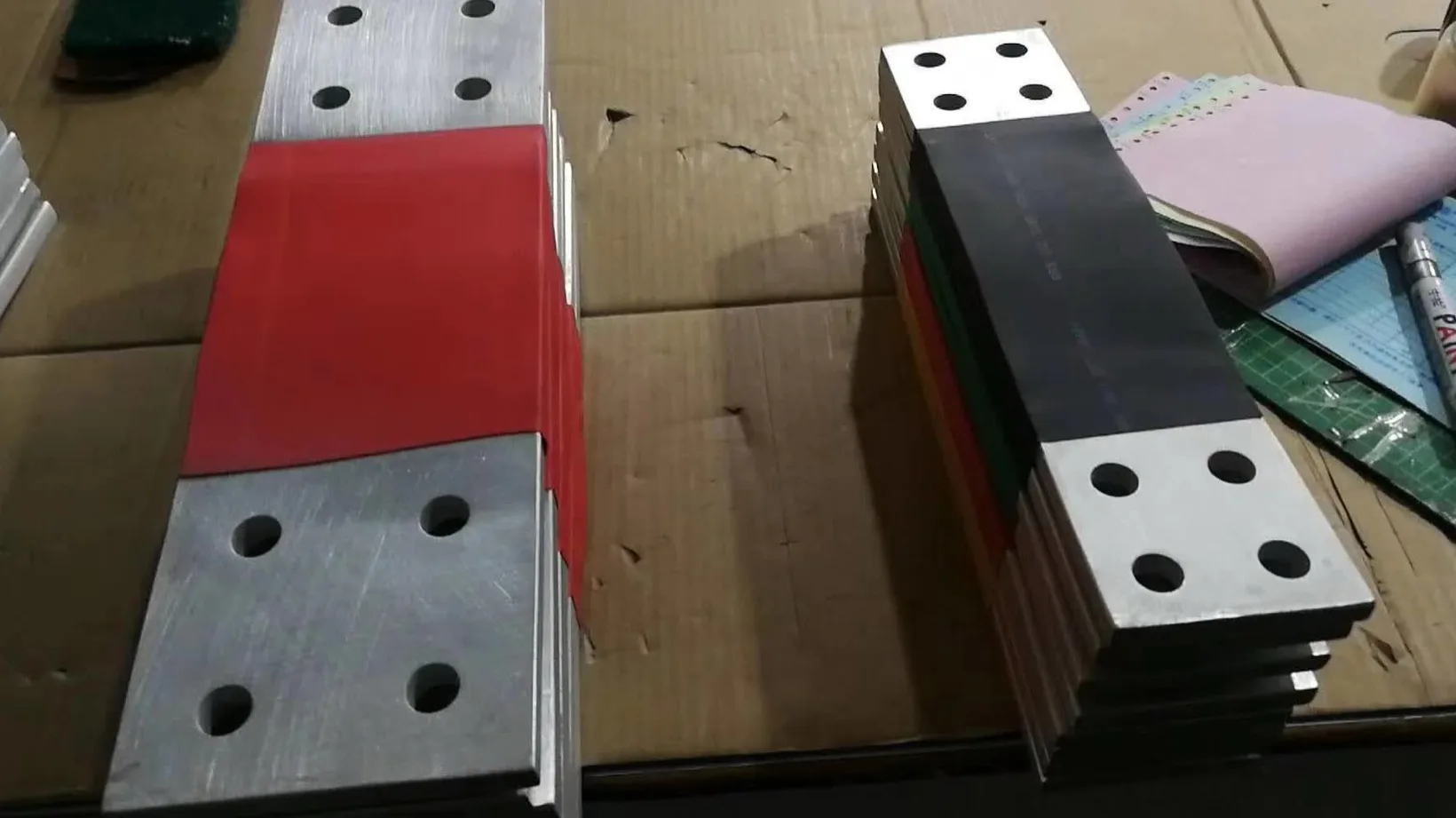
Everything that has to conduct or be welded must stay bare, and the mask line is a real dimension with a real tolerance. Two things to specify: which surfaces stay bare, and how close the coating may come to the edge of the pad. Powder builds a small fillet at the mask line, and a bolt head or clamp that lands on that fillet will not seat flat, which shows up as a high-resistance joint rather than as a cosmetic defect.
How the coating is verified
Corrosion resistance is run as neutral salt spray to ISO 9227 salt spray test method, with GB/T 10125 adopting the same NSS conditions, so a report under either standard is directly comparable. Adhesion is graded by cross-cut to ISO 2409, identical to GB/T 9286, reported as a class from 0 to 5 rather than a percentage, with industrial work normally accepted at Class 0 or 1. Electric strength is measured to IEC 60243-1 or its identical Chinese equivalent GB/T 1408.1. Results for your part, at your film thickness, are issued with the first article, and the full sequence is on our busbar testing and inspection page.
Epoxy powder or PVC dipping
| Epoxy powder | PVC dipping | |
|---|---|---|
| Film thickness | 0.3 to 0.6 mm | 0.4 to 0.8 mm |
| Dielectric strength per mm | Higher | Lower |
| Temperature | Higher | Around 105 °C |
| Dimensional control | Tighter | Looser |
| Impact and abrasion | Hard, can chip | Elastic, forgiving |
| Best for | Thin layer, tight fit, higher withstand | Moisture, salt, handling |
Where the part meets condensation or rough handling rather than high voltage, dip coating for moisture and salt exposure is usually the better answer. All four methods, including heat shrink and molded covers, are set side by side on the all four insulation methods side by side.
Where coated busbars are used
Inverters, converters and traction equipment take most of the volume, because the parts sit close to hot semiconductors and have to fit defined envelopes. Battery packs and energy storage cabinets use them where creepage and clearance are tight. Switchgear and distribution equipment use the same process at larger cross-sections. Safety requirements for the surrounding battery system are set out in IEC 62619 safety requirements, and stationary storage programs increasingly ask for evidence against the UL 9540A test method for thermal runaway propagation.
From drawing to coated part
Send a 2D drawing or a 3D model with the masked areas and the withstand voltage marked. From drawing approval, expect 3 to 7 working days to a first article on existing tooling, or 10 to 20 if a new tool is needed, with coating and cure adding 2 to 4. Materials, processes and capacity are on the how custom busbars are quoted and built page.
Frequently asked questions
- Are you a busbar manufacturer or a trading company?
- A manufacturer, and the coating line is ours. That matters here more than on a bare part, because a coating fault has to be traced back to the copper it went onto, which is not possible across a subcontractor boundary. The plant is in Foshan, China, open to visitors by appointment.
- How thick should the coating be?
- It follows the withstand voltage rather than a fixed figure. Most low-voltage work lands in the 0.3 to 0.5 mm range; a higher specification is built in passes. Tell us the test voltage and the operating temperature and we will confirm the build.
- Will powder coating cover a punched edge?
- Yes, electrostatic wrap pulls powder around edges far better than liquid paint. Coverage is still best on a deburred or radiused edge, and worst inside deep recesses and tight bends, which is why the geometry is reviewed before the first run.
- Can you coat a bar that is already bent?
- Yes, and that is the correct order. Bending after cure is what cracks the film. Send the part formed to final shape.
- What are the disadvantages compared with PVC dipping?
- Two. The cured film is hard, so it chips rather than deforms when a corner is knocked on the assembly line. And it tolerates less movement, so a part that is clamped rigidly at both ends and cycles through a wide temperature range is better served by a flexible construction.
- Do you supply prototypes as well as production quantities?
- Yes, and both go through the same oven on the same hangers. A sample validated at prototype stage therefore carries the same film build into production, with no requalification because the process moved.
Request a quote
Give us the film thickness you need or the withstand voltage you have to reach, plus the operating temperature and the masked areas, and we will confirm the build. Start an RFQ.